Outed

English: JW Armband

One of my friends got “outed” recently. Apparently her crime was that she was friends with people whose lifestyle seemingly contradicted the morality code of the organization she worked for. Let me remind you, she didn’t actually engage in any questionable activities. She was guilty of being in relationship with people who engaged in things her organization disapproved of. She is guilty of taking a soft stand on a controversial issue. This is not a fictitious event.

Like most employees and and organizational types she had felt that she was part of a tight-knit community. These were friends and honorary family members. She feels the sting of rejection and it has become apparent that her friends were judging and rejecting her. She has been, albeit subtly, shunned by her tribe.

Ask an ex-Jehovah’s Witness what it’s like to live outside the fold. Ask a Christian who cannot be a part of something she once loved. Ask the gay kid trying to get by. Ask the husband rejected by his ex-wife’s family. Ask anyone who ever had to swim against the current. Ask the hero who fell from grace.

Anyone who tells you that it’s better being a round peg in a square hole doesn’t know what they are talking about and isn’t a round peg. Being an individual is painful in a society that is glutted with conformity and compromise and pretty rock stars buying illegal monkeys, superstars with perfect teeth and no moral backbone. The pressure to conform is intense and real.

What a wonderful thing it is, and a curse, to be an original – (stolen so long ago I can’t remember the author)

Jealousy And Obsession

Man thinking on a train journey.

I work a great deal with people who are in the throes of an obsession. It may be a love or a love lost, a new hobby or a destructive coping mechanism. No matter what the cause, obsession can be a powerful and consuming thing. The longer I work with clients the more apparent it becomes that a manic state is in many ways as destructive as a depressed state. Some of that emotional energy I have seen during a relational breakup, for example, is very destructive. Checking your email or Facebook every two minutes, writing out dozens of extensive apology or spite letters, overdoing it at the gym or at the bar or even at your church – manic obsession is not healthy.

Jealousy is a great example of how manic behaviour and thinking can get out of control. It can be insipid, especially if it appears justified. Sometimes we are jealous of another for good reason, at least we think so. This often leads to excessive passive-aggressive behaviour, incredible neediness, controlling and manipulative relationships, and eventual emotional ruin.

I know a little bit about jealousy. There was a time in my life when I was convinced that someone I cared about was attracted to another. The fact that I was eventually proven right actually was worse than if I had been mistaken. Fuel for the fire, so they say.

I have come to realize that most often jealously is actually about me, not the other person. If I am insecure, or envious, if I am needy or convinced that I am unworthy, this has a tendency to exacerbate any legitimate feelings I may possess. Finding out your spouse is enamored with some other guy or girl is bad enough when you are healthy. If you are an emotional train-wreck it can absolutely devastate you and those you are in community with.

Obsession.

Jealousy, like rage or fear, is an exceedingly powerful and consuming emotion. It turns otherwise rational people into psychotic idiots, passive people into tyrants, happy people into pathetic messes. Some of you know what I am talking about. Objective thinking goes right out the window. Like other obsessions jealousy takes up most, if not all, of your head time and thoughts. You start to catastrophize everything, think with your heart and not your head, live in a constant escalated state of pain and anxiety. Jealousy is almost impossible to talk someone down from.

Breathe.

Those racing thoughts are not healthy. Letting yourself dwell on the possibilities only makes you sicker. Trust me, you don’t need to feel all your feelings. You don’t need to process your pain twenty-four hours a day. What you do need is to put the brakes on the insanity and eat some chocolate, get laid, go to a movie, take a nap, or spend some time in prayer or meditation. Find out about mindfulness. Look into distraction. Talk to a doctor about Ativan. Read or listen to a book. Get sleeping pills. Give other people permission to tell you to shut up every now and then. Dwelling constantly on what may or may not be is a great way to go insane. Talk to a professional. Learn STOPP Therapy. Work on those racing and irrational thoughts. Deal with your self-esteem and insecurity and childhood issues. Stop the train wreck.

Realize that no one else can make you happy forever.

Stop Dating Until You Don’t Need To

"A serious relationship"

I often tell clients not to date until they don’t need to. The fundamental premise behind such a cliché is that if I am unhealthy, or needy, or on the rebound, or broken than any legitimate concerns I have become massive, obsessive. I begin to catastrophize what is going on. I lose my objectivity and it isn’t long before I have a hole in my heart that I am looking for someone else to fill. Dating when you are vulnerable or broken is a sure-fire recipe for relational strife, no matter what Cosmo tells you.

Finding the right person has less to do with romantic bliss than we have been led to understand. Being the right person – whole, happy, not needy, that is the right goal to pursue. If I am healthy enough that I do not need another to fix me or complete me (gag) should be our goal. Dating then becomes an opportunity to share who we are with another without the needy blinders on. Settling for whatever is available isn’t even an issue.

Singleness is not a disease.

I was a single parent for years and after I got over the self-indulgence, the pity, the tears and the loneliness I began to realize that it was awesome to be alone. The healthier I got the less I needed a woman to approve of me or assure me I was ok. By the time I did date again I was not an emotional vampire that needed to be filled. I found I was no longer as needy as I once was. I began to like who I was. All of this was only possible once I learned to live with myself.

I can honestly say I like myself today (I find that hard to write). I still don’t like what I look like in the mirror or some of my obvious faults but for some reason that doesn’t hurt like it once did. Singleness was a gift that I never wanted. It was a gift that changed my life.

If you are single today it is perfectly normal to experience loneliness and momentary unhappiness. I believe they call that “life”. You are not a second-class citizen, a third wheel, or the odd person out. You are free to be who you truly are. Don’t miss the opportunity, like I almost did, to allow yourself to learn who you really are apart from someone else with all their baggage, needs, quirks, foibles and insecurities. If you aren’t complete without someone else filling that hole in your heart chances are you won’t be complete with someone there.

Trust me on this – don’t date until you don’t need to.

The Emotional Tank

Years ago I heard a talk about our four gauges. Let me explain.

The speaker spoke of the various internal gauges that he had noticed in his life. He had a spiritual gauge and as a religious person he felt that this tank was regularly filled. Think of a gas tank. When the gas runs out, the engine stops. He also noticed his mental gauge – as a scholar he kept that tank filled almost all the time. He was also a marathon runner and knew implicitly that his physical gauge was good. So he was in tip-top shape right?

Wrong.

What the speaker did not realize was that there was a fourth tank, an emotional tank. People who are caregivers, or young parents, or counselors, or that ilk are required to empathize with people, to care. You can jog all you want and it won’t fill your emotional gauge. It might be therapeutic but it probably isn’t enough. After a while people who constantly give out begin to “skim” emotionally. They still care in theory but becoming emotionally involved gets to be harder and harder. It is no wonder, then, that many caregivers have secret addictions, or masturbate more than most, or engage in risk-taking or risqué behaviours.

I have arguable the easiest job in the world. I get paid to sit and drink coffee all day and listen to people talk about their issues. When I first starting doing this I heard of counselors going on stress breaks – and laughed. I had just come from owning a restaurant and I knew what stress looked like, or so I thought. Coming to work was a break from my stress, not a contributor to it.

For a while.

After a few years I started to notice I didn’t care as much, didn’t work as hard, didn’t engage emotionally like I once did. I became easily irritated and struggled to emotionally engage with my family. I had no idea what was happening.

Then I remembered the emotional gauge.

Today I listen to audiobooks and do martial arts. I listen to a lot of audiobooks, hundreds and hundreds. On this computer alone I have 63 gigs of audiobooks and that isn’t even my biggest collection, which is on my removable hard drive at home. I listen to philosophy, brain candy, psychology, sci-fi, physics, pop novels, comedies, history etc. Right now I am listening to The Rise and Fall of the Third Reich, a massive chronicle that I have now read almost three times. I use the word “read” figuratively. Last week I listened to Dune (it sucked) and before that Physics Of The Impossible (amazing). I cannot get in my car without an ear-bud attached, it is a full-blown addiction – and very therapeutic. Listening to books fills my emotional tank.

We all have an emotional tank, and when we are stressed or anxious or busy it gets depleted. By now most of us know we should practice self-care but most still cannot make it a daily or even weekly priority. Self-care takes time and we are too stressed or anxious or busy to take that time. It is a vicious circle that keeps us mentally and emotionally ill.

Self-care can smell an awful lot like selfishness, especially when you are trying to drink a daiquiri on the back deck when the kids are screaming for your attention. The tyranny of the urgent is forever clamouring for our attention and we have been taught that self-care is optional, or laziness, or self-indulgent.

This weekend when I get in my kayak it will feel selfish for a minute or two, until I put in my ear buds and return to The Battle Of Britain. When I get home I’ll try to convince my wife that I am practicing what I preach… and perhaps she’ll buy it.

Either way I get to go kayaking.

Three Quick Parenting Tips

It’s the latest trend in parenting and it may be the best advice you can receive this year. Parenting is an incredibly difficult thing and most of us can use all the help we can get. So here are my three quick pieces of advice that can make a huge difference in your parenting technique:

1. CTFD: To see it in action, here are some sample parenting scenarios and how CTFD can be employed (via Huffington Post):

  • Worried your friend’s child has mastered the alphabet quicker than your child? Calm the f*ck down.
  • Scared you’re not imparting the wisdom your child will need to survive in school and beyond? Calm the f*ck down.
  • Concerned that you’re not the type of parent you thought you’d be? Calm the f*ck down.
  • Upset that your child doesn’t show interest in certain areas of learning? Calm the f*ck down.
  • Stressed that your child exhibits behavior in public you find embarrassing? Calm the f*ck down.

Understanding how much your children are affected by your energy is a key to wrestling back control in your home and life. Few of us want to admit this but we know that techniques like yelling do nothing but jack up the tension and make a stressful situation only worse. Strategists will tell us that if you want to control the argument you need to control the environment. It just makes good sense, therefore, that children are confronted with collected calm and self-control. Children are going to emulate your stress level and imitate your energy so quit the yelling, the drama, and the tears. Crank down the intensity and control your emotions when you are engaging an upset child. Calm energy creates calm energy – don’t forget that.

2. Don’t Get Sucked In: Building on the idea of calm energy it is critical to understand how tempting it can be to become emotionally involved. When we are drawn into the stress of an argument we lose our objectivity and begin reacting, not responding rationally. Recently my fifteen year old marched up to me with an emotional point to make. He proceeded to beak off about something he was mad about, seeking to engage me. He was out of line and hoping for a reaction so I didn’t give him one. It is amazing how frustrated a teenager can become when you are smiling at him but ignoring his anger. After a minute or two of trying to get a rise out of me he acted disgusted, shook his head, and said, “I’m just going to go ask mom”.

It’s very hard to argue with someone who refuses to be sucked in.

3. Stop Micromanaging Your Teenagers. Parenting is about learning to let go, one argument at a time. There are a million things you could try to fix on your teen but it is crucial that you don’t fight every fight, no matter how tempting. Parents of teens (and for some reason more moms than dads) often struggle when their obnoxious pimple factory informs them that every other teen in Canada gets to go to bed at a certain time and they should too. When is it the right time to let them see a Restricted movie? What is with all the sleep-overs? Should you let them wander the streets at night? What video games are appropriate? How old should they be before they can go to parties? or date? or drink?

It never feels like the right time to let go. Kids are ridiculously stupid and will undoubtedly make the same big mistakes you did unless you steer them constantly.

My dad once gave me some great advice about parenting and since he was a great parent, I thought I should probably listen. He told me to stop micromanaging the kids. He warned me that if I exasperate the boys with too many rules and too rigid of enforcement that they would grow frustrated and rebel. It was very good advice. I am therefore forced, because of this sage wisdom, to pick my battles and let a lot of things go. This is difficult to do if you are the kind of person who appreciates rules or has difficulty with change. As my dad reminded me, “You can win the battle but lose the war”. I try to remember this as I wade through the fallout zone which used to be his bedroom floor.

Three quick things – drop the energy level, don’t let it get personal, pick your battles; easy to understand and virtually impossible to follow without effort. I have found that change, real change, takes far longer than we initially thought and is usually much harder to accomplish. Most people do not really change because change is very hard and the cost of growth is enormously high. Real growth doesn’t happen in a week, or even a year.

  • Ctfd (scott-williams.ca)

Coping Mechanisms

coping

We all have them.

We have adopted ways to deal with the reality that we are stuck in. Very young we may have realized it was better to keep our emotions to ourself than it was to get hurt by an abusive mother. Some of us had to get angry to get our way. Checking out during sex was a way to endure something we did not enjoy. Maybe you cry and pout until you get your way. Perhaps you believe you should never show weakness. You might use sarcasm and humour to evade being honest or vulnerable. Feeling sorry for yourself has been a way of feeling better about yourself. Passive-aggressive behaviour really does work.

No matter what coping mechanisms you use they have probably worked for you in the past. Checking out during sex or an argument or a compliment really did help keep you from being hurt. Anger really did help you get what you needed, once upon a time.

The problem with coping mechanisms is that they were formed many many years ago, as a response to trauma or terror. You probably developed your fear of confrontation when you were three or four years old. No doubt you formed your skewed version of the opposite sex when you were a child or in puberty. The ways you interact sexually were learned before you really had any idea what sex was all about. Your perception of your father or mother was forming as you were learning to walk. You based your entire belief system, back then, on your immature and basically stupid beliefs about life, love, reality, and the meaning of life that you developed when you were a dumb kid. Twenty years later you can still hear the kids on the school yard calling you fat, or ugly, or stupid, or all of the above. That seven-year old’s hurtful comment about your weight still affects you today. Amazing, isn’t it?

It may be time to look seriously at some of the coping mechanisms you have been using for years. It may be time to come to grips with the fact that you have been feeling bad about yourself for thirty years based on the opinions of a bunch of cruel elementary school brats, or a dad who was an alcoholic and still isn’t a real person. Yelling may have been a necessary skill in your home growing up but it isn’t working for you anymore and it’s time to let it go. Perhaps it’s time to say goodbye to that voice that you know that keeps telling you that you are stupid, or ugly, or worthless. That person’s opinion isn’t worth a damn thing and you know that intellectually. Refusing to let people in has worked in the past but it’s holding you back now. I know you said that you would never trust again but at the time you were very wounded and your emotional tank was tapped.

At the end of the day it often comes down to Einstein and his crazy-haired definition of insanity – doing the same thing and expecting different results. That’s it, isn’t it. Destructive coping mechanisms have long since stopped working but we continue to think that we have to listen to their insipid voices. You can rebuild trust, or confidence, or hope. You can move forward.

It’s just really hard and takes more time than we want. It is, however, incredibly worth it.

6 Ugly Truths You Need To Accept To Pull Yourself Out Of A Rut

Great Article via The Huffington Post:

They aren’t pretty, but they are the kind of wake-up calls that we need to give ourselves every once in while. Columnist Leigh Newman explains.

1. Love Is Not A Stative Verb

In elementary school, we were all taught about stative verbs. Perhaps you remember them? Statives are those verbs that describe a state of being or mental condition, such as “to feel” or “to be” or “to believe.” Love, for example, is classified as one. You feel it.

Now let’s look at a few situations that have me questioning how this grammar plays out in life outside the classroom. Example #1: My friend who keeps sending his mentally unstable mother $2,000 a month even though she is young enough to still work and racks up debt on credit cards that would make a gambling addict panic. Example #2: My 42-year-old girlfriend who keeps meeting the same 42-year-old man over and over and over at 1 a.m. at which point he shyly, drunkenly, adorably reveals that she is his soul mate, only to go back to his 27-year-old fiancée at 7 a.m.

These kinds of dynamics — and others like them — have recently persuaded me that love is not a condition or a state of mind. Love is not a stative verb at all. Love is a dynamic verb. Love is action. Love is dumping the 27-year-old fiancée. Love is refusing money from your son because he’s taken on two moonlighting jobs to support you and he can’t afford his rent, much less the black Lab he’s always wanted. Love is sprinting, struggling, splatting, crawling, kick-boxing, climbing, leaping into the thick of the battle for your own — and someone else’s — happiness.

2. To Learn Is To Watch… And Ask

Like many Americans, I am a teach-it-yourselfer. So is the rest of my family. When I wanted to learn how to play tennis, my dad dropped me off at the local high school with a racket and a tube of three green balls, and told me to hit the backboard “until I got the hang of my swing.” As an adult, when I need to screw on a ski rack or create a Google spreadsheet or cook an obscure Chinese green, I figure it out via trial and error. Why? I think I’ll understand the task more profoundly by teaching myself. A recent study at the University of Louisville however, found that figuring things out yourself takes longer — with far less accurate results — than observing and communicating with others in the know. Watching the experts — and asking them for their expertise — results in a faster, richer learning curve.

3. Pig Newtons Are So Fig Newtons

Fig Newtons

Be they disempowered toddlers or exhausted parents or fed-up coworkers or confused, random, mentally unstable strangers on the street, our fellow humans sometimes make up insanely stupid points — then fight fiercely in defense of them. Only Louis C.K. can make this funny. But he does have a point. People — and not just kids — will insist Fig Newtons are actually called Pig Newtons. They will claim Mississippi has seven s’s in it. They will swear the sun covers the moon during a lunar eclipse. Your job is not to argue or present the truth to them. You will not get anywhere and you will turn into the crazy person trying to argue your case. Your job is to go to the bathroom and laugh. Or write down your insanely correct points on a piece of a paper towel — and then flush them down the toilet.

4. When Overwhelmed, Cache And Drag

During the Gold Rush days, on the famed Chilkoot Pass between Canada and Alaska, each traveler was required by the Mounties to drag one full ton of “adequate” food and supplies up the 32 miles that led over the icy summits. Some of these travelers, by the way, were women wearing corsets and long, full skirts. And yet, they succeeded. How? By caching (read: storing) 950 pounds of their supplies by the side of the path, then dragging (read: dragging) a mere 50 pounds for a half a mile forward, then returning to the cache for another 50 pounds, and so on. When it all worked out, a person might walk 80 miles for every single mile they moved their provisions — which sounds discouraging. But in this way, they were able to move — literally — a mountain of food, pots, tools, water and everything else they needed to build a new life. I’m not suggesting that any of us pack up the contents of our house and drag them in 50-pound bundles through the streets. But sometimes, it can be helpful to put an idea or dream to the side for a while and then, in full defiance of our relentlessly go-forward-at-all-costs culture, to go backward and haul the crucial supplies necessary to make it come to fruition.

5. You Don’t Have To Go To The Gym To Work Out

At home, I have a set of free weights, two yoga mats, an elliptical trainer, three yoga videos and a nifty package called OM Yoga in a Box. I haven’t touched any of it in months. The workout that I do is pushing my 35-pound 4-year-old two miles each morning over to “Super Hero Camp” in the 90-degree heat. I exercise my arms and legs. I sweat off five pounds. The news that you don’t have to go to the gym to work out should be a wonderful truth instead of a hideous one. You can run up the stairs to your office. You can pick up your husband and put him down over and over. Right now, you could be running in place while reading this article. Amazing! Wonderful! But think about it: You don’t have to go to the gym to work out. That means you can work out anywhere and anytime — which means all those lovely lies about not being able to work off your stress and take care of yourself are now officially unutterable.

6. You Already Dreamed The Dream

I’m not sure who is going to invent a machine that will inventory everything that goes through our brains, and until this is actually invented, this last truth may have to be reclassified as a hunch.

But it does seem as if so many of us worry that we don’t know the one crucial thing that we should be doing in life, the thing that will fulfill us more than any other. Even if we were given all the time and resources in the world, we still wouldn’t know what to do.

This is ridiculous. From what I have seen in life, I don’t think we need to go looking for some new “mystery” dream. The most important ones we’ve already had. Sure, at a very young age the idea of being a sea captain or ballet dancer occurred to us. But at an older, wiser age, we thought, “I should own a bookstore!” or “I love jam so much I should make it” or “Wouldn’t it be fun to be a tour guide in Italy?” We just failed to tie our lives to it. We let it float off, where it eventually ran out of air, sank and got buried by 1,000 other more practical or less scary or far less specific dreams.

It feels a little horrible to confront the truth that you knew what you wanted to do (even for .04 seconds) and didn’t do it. Then again, understanding or maybe just believing that the dream exists and that we just have to root around for it — not invent it into being — does something amazing. It calms us down. It takes away all the side worries like, “Maybe I’m not creative enough to dream” or “Maybe I’m just one of those people who don’t dream.” Looking for it becomes like looking for a missing house key while still at home; there’s no need to panic. You just have to find what’s already there.

Married To Jesus

A true story given to me by a friend of a friend of a guy I used to know. It’s been sitting in my Inbox for some time now and I couldn’t find any good reason not to share it with you. It’s about living with a very nice Passive-Aggressive…

female jesusI used to live with Jesus, or so I thought. She was different from the people you would probably know – after all, most people don’t ever get a chance to even meet the Messiah, much less live with her. But I did.

People usually act differently in public than they do when no one is there to see what they are doing. Not Jesus. It was scary how consistent, how absolutely unflappable she was. Life is an exercise in guilt when you are married to the Holy of Holies. How do you get mad at someone who is always the same? How can you fight with someone you sometimes believe is always right? When you are married to the King of Kings it’s always your fault. Feel unloved? It’s your problem. Frustrated by her lack of empathy or the fact that she never panders to your emotional needs? Get over it, this is Jesus we’re talking about.

Living with Jesus is hard on your sense of self-esteem. After all you are clearly not worthy. People often remark, “I know why you married her but why did she marry you?” You are in love. You worship Jesus. You have a very twisted marriage.

But she wasn’t really Jesus. It wasn’t until much much later that you realized she was actually very repressed, very emotionally unavailable, distant. She was a textbook illustration of Passive-Aggressive Personality Disorder. There was a whole world of anger and pain all closely hidden from the world, hidden even from you. You literally had no idea she was even remotely unhappy. That person whom you thought was perfectly happy and reasonable was in fact a deeply wounded and angry little girl who clearly had issues with self-awareness and vulnerability. There was even what some would call a passive-aggressive arrogance – quietly confident that in every situation she was always right.

The lack of emotional vulnerability contributed to my growing sense of neediness and romantic starvation. Jesus was apparently above feeling horny or expressing romantic intention. She also did not like to throw around phrases like “I love you”. She was an island and she expected everyone else to be likewise. Years later her best friend would confess, “I really never knew her. I don’t think anyone really did”.

No she wasn’t Jesus. In fairness she never asked to be put on a pedestal. I think. I was looking for a soul mate and she was looking for a business partner.

After almost two decades of being a burden she cut me loose to go “find herself”.

She said she couldn’t stay with someone who was needy.

It has been a while now and time has given me the insight that all those years of marriage could not. It turns out I was a pretty decent husband after all. Spending every day trying to impress the Christ will do that to a person. Apparently she was not perfect, though I would never have believed it.

No one is disappointed in me today. I haven’t failed yet today.

It’s going to be a good day.

Drug Myths

excellent article from Cracked.com

Natural Drugs Aren’t As Bad For You!

The Myth:

This one you’ve heard from your hippie friends: “Don’t believe ‘The Man’ when he says all recreational drugs are bad for you! What I’m giving you are but plants and mushrooms that grow from Mother Earth herself! It’s far better to put something natural into your body than some chemical that came out of a factory!”

The Reality:

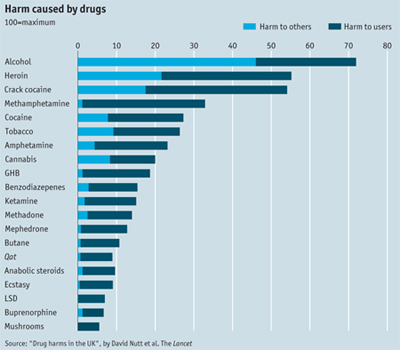
Let’s start with the obvious: A substance being “natural” means precisely squat in terms of its potential risks and benefits. For example, opium, which is squirted straight out of a poppy, is a highly addictive narcotic that can easily kill you dead if you overdo it. Check out this chart comparing all the drugs the popular kids are doing nowadays:

Drugs on the lower left are safer, while ones to the upper right are dangerous-er. Note that everyone’s favorite natural drug, marijuana, is just about on par with perhaps the very definition of a synthetic drug — LSD — in terms of lethality, while being higher up the dependence ladder. And hey, check out alcohol up there playing alongside cocaine and morphine and heroin like he thinks he’s one of the big kids or something. At the risk of causing you to fall into a PowerPoint-induced catatonic state, here’s another chart for you to take a gander at:

This one’s the result of a study led by neuropsychopharmacologist David Nutt to rank drugs in terms of the harm they cause to their users and others. While the vegan-friendly mushroom is at the bottom of the list, it’s not so far behind Ecstasy and acid, both puked out of some laboratory beaker somewhere. Pot and tobacco are up there near the top mingling with Walter White’s favorite synthetic drug, and hey, look at that: Alcohol takes the very top spot. It probably seems like we’re bullying poor little booze at this point, but we contend that he’s asking for it.

So just because a drug is natural, that doesn’t necessarily mean it’s any safer — sometimes, it’s quite the opposite. We mentioned above that the poster child of synthetic drugs, LSD, can cause its users to go on psychotic rampages if they’re predisposed to them. Do you know which other drug can do that? If you guessed the poster child of all-natural drugs, marijuana, give yourself one (Acapulco) gold star.

Rempel Island

Scott SkiingI love slalom skiing. Wakeboarding is fine. We even surf behind the ski boat these days. There is something, however, I love about that feeling of creating a big rooster tail, feeling the rhythm, living in that moment. I don’t own a boat (I whine about that here sometimes) but I have a good friend who will, if I pout enough, take me for a ski every now and then. This past long weekend we launched the boat on the Fraser River and took a cruise towards Vancouver, had lunch on Rempel Island… and I got out the ski.

Fraser RiverSomething happens to me when I water ski that rarely happens in the real world. I can truly, for a few brief moments, live in the moment. I’m not thinking about the mortgage or my problems, I don’t even care about my family or my finances. All I want to do is cross the wake and lean. I’m not a great slalom skier but I am a decent one and so I don’t have to think much about falling or screwing up. I just “am”.

About a month ago we went skiing on Alouette Lake during an overnight campout with two of my kids, my ski boat buddy Rod, and a lifelong friend Martin. We woke up Sunday morning and soon realized that no one, not a single person, was on the entire twelve-mile long lake. I put on the ski and dipped into the 72 degree water. Within seconds I was up and began the rhythm, the poetry that is slalom skiing. I was alone on a lake surrounded by mountains on all four sides, the water was glass and warm. I was fully alive.

Zen.

I wish more of my life was like those moments. Too much of life is lived looking forward or backwards, worrying about stuff and people and problems, trying to make a living while wishing I was in Rod’s boat. Life has a way of taking up most of our time. Few of us are rich enough to spend our life waterskiing. It’s tempting, isn’t it, to pine for that which we do not have and miss out on the blessings we should enjoy.

Mindfulness. In counseling I talk about it all the time but often fail to live it myself. Mindfulness is allowing yourself to be in the moment, enjoy the journey, and appreciate what is happening right now. We are a discontented people who have been raised with champagne wishes and caviar dreams; never satisfied and constantly stressed.

I got a little Pelican kayak for my birthday last week from some good friends and family who know me enough to realize that I need to paddle something. For most of my life I have been passionate about whitewater canoeing. I have canoed the Nahanni, the Clearwater River, the Foster River, the Muskeg River, several rivers in Colorado and northern Canada. I’ve done the Kootenay River four times now with my boys, my brother, my dad and my best friends from Alberta. When I dream of canoeing I dream of the Churchill River, of Great Devil Rapids, of wrapping a canoe around a rock on Donaldson Chamber with my old friend Don Hand. Paddling is in my blood and I have tried to instil that love in my three boys. Floating down Otter Rapids in your life jacket is something everyone should do at least once in their life. I have memories of friends and moments, so many moments, that will stick with me for life. My happy places – rivers and lakes and slalom skis and Rod’s boat.

I am trying to live other moments as well. Moments at work, playing with Angus, kissing the people I adore, talking with friends, playing in the band. It’s tempting, isn’t it, to forget to enjoy what is happening at this very moment and dream of times long past or dreams to come. Mindfulness reminds me to smile right now, even on dry land.

I’m still going to paddle my new kayak out to Rempel Island this week.

Making It Work After Someone Cheats

The Pleasure and the Pain (1963) ...item 2.. M...

Not everyone can do it. I’m not sure I could, to be honest. Many couples choose to stay together after infidelity and I salute them. Remaining together is one thing, trusting ever again is another. So if you are in this situation, what can you do?

Earning trust back is a monumental task requiring an incredible amount of humility from both partners. It takes way longer than people want to admit. I have, however, seen couples who are committed to making things better, in spite of the horror and the obsessive thoughts, jealousy, and pain. Sometimes.

Working as a counselor I have, as you can imagine, my share of marital issues to wade through with people. Nothing comes close to the difficulty of rebuilding trust and safety. Trust and safety – two words that constantly come up when I talk to clients, especially female ones.

People don’t generally understand how devastating infidelity can be. For the partner who has been rejected (yes I said that word) the process can take years, if ever. There are nights and days of obsessing about the “why” of it all, about how they have failed as a lover and a spouse. There are hours and hours of anger and more obsessing. Even being touched by the cheater becomes loaded, and potentially volatile. The spouse who has cheated is often subjected to months and years of the “short leash”. They are forced to phone more often, report in more often, talk to potential attractions much less often. Sometimes there is punishment and condescension, anger and vengeance. The one who is on the short leash usually grows tired of the lack of trust. Why can’t your partner ever seem to move on?

Spouses who cheat, especially men, are prone to verbalize how tired they are of not being trusted. Many will, after some months, flatly refuse to jump through any hoops or even talk about the infidelity… yet again. They are sick of the same tears, the same logic, the same belittling. A surprising number of relationships break up a year or more after the actual incident. Things just won’t seem to go away and both partners are not getting what they need.

If you have been betrayed in this way the first thing you need to understand is that there is no template for how to respond correctly to such a nightmare. It’s so easy for counselors to give out prescriptions for happiness but the sad truth is that most of us are permanently damaged. There can be forgiveness, even reconciliation, but the relationship will change. For some of us leaving is the only emotionally healthy option.

If you or someone you love is tortured by infidelity, either their own or someone else’s, encourage them to talk to a professional. The most important part of moving forward is personal healing, no matter what the outcome. Learning how to process what has happened is the key to healing. Time doesn’t hurt either.

No one really knows what you are going through although some of us can understand that pain. Whether it’s your parents or your partner you owe it to yourself to do everything necessary to be whole again. You’re worth it, in spite of how you may feel right now.

Birthday Reflections

He was obviously at least twenty years older than she was. He was also ignoring her as she texted away, seemingly oblivious to my stares. Why was she with him?

They got into a Mercedes. I know I shouldn’t speculate but I have known many clients, often more female than male, who are attracted to people with money or power. I have a hard time getting my head around such a desire but I know it exists and is doing quite well.

If there is any moral lesson to The Wedding Singer it’s that you should do what you love, rock that mullet, and damn the money. Corporate sellouts with feathered hair and a taste for Heineken will ultimately lose the girl to the hobo guitar player and his pure love.

It can happen. Some people love musicians. I’m fairly certain, however, and I’m not really going out on a whim here, that more people, way more, like money and all the spicy things money can buy. If you fall in love you might as well fall in love with someone who is rich, right? Musicians may vibrate my crazy bone but a lawyer with a Maserati keeps on giving. The meek may inherit the earth but the rich suffer in comfort. Money may not buy you happiness, as the comedian said, but want to know what really doesn’t buy you happiness? Poverty, poverty does not buy you happiness.

Many of us find security important. It would be, for lack of a better illustration, on the Top Three List Of Our Values. It’s easy to be idealistic and want to save the world when you are twenty and will never grow old. It’s another thing altogether when all your friends are retiring and you are a greeter at Wal-Mart… again.

I want a ski boat. I’ll never get one but it’s still nice to dream of water-skiing on Alouette Lake on a warm Sunday

Alouette lake May13-07, late afternoon

morning. It’s tempting to believe that my life would be incrementally better if I only had a boat. It’s not true, but it’s easy to that it is. It was easier to be idealistic when I was younger. I still want a ski boat.

Being true to who you are and what you want out of life can be hard. It’s tempting to wander down little side roads that promise something quick, easy, and free. It’s often difficult to continue to give when you see others benefiting so heavily from taking. Most optimists end up as realists, pessimists who aren’t very self-aware. The rich do get richer and sometimes the assholes win. Often. Other people do have it easier than you might. Some of my friends did fall accidentally into opportunities I never had. Some did worse, but they don’t support my argument so I’ll pretend they don’t exist.

So many bitter old people. So many of us who have forgotten what we loved about living, forgotten to tip our heads into the sunshine. We have taken ourselves too seriously. There has been too much trauma, too much ‘water under the bridge’. Life is routine and pain and boredom and drama, all wrapped up into a little financially strapped ball of poop.

Learning to understand why your life has meaning is perhaps the meaning of life. Making peace with your demons, putting your hurts to rest, and refusing to get old and bitter, these are the real spiritual quests before us. Amazing lives are no accident. Spending more time reading psychology and philosophy, even theology defines those who are on a quest to be more than they were. Wisdom is the goal, contentment the gift.

It’s my birthday today and I’ve decided that I don’t want to get bitter, growing older. I really don’t want to spend the rest of my life feeling sorry for myself, blaming things on others. There are still scary and challenging mountains to climb, it’s just more and more tempting to sit on the sidelines. I want to be that old guy who is so alive he cannot be ignored.

Like my dad.

The Hidden Cost Of Entitlement

Bling Bling Bling Bling Bling Bling Bling Blin...

There is a great deal of virtual ink on the topic of entitlement. By now most of us are up to speed on the effect entitlement can have on our lives and the lives of those we love. Parents are learning first hand how selfish, how self-absorbed, how… well… entitled kids seem these days. They must buy a house that looks better than the one their parents saved twenty years to purchase. They don’t drive older cars, they simply aren’t safe. Everyone is entitled to a Smart Phone that their parents pay for. Manicures and pedicures, tattoos and product, it’s important to spoil yourself too. But there are costs and not all of these are obvious.

Entitled people build a world that they are comfortable in. Because they believe they deserve stuff they usually live in the now without too much regard for the future. They do what they want and they do it now. Don’t tell them to do something they hate now for some nebulous reward in the distant future, they can have it now and they will plan on having it in the future as well. They have no plan but a solid belief that they deserve it. Party on.

It becomes very difficult to live a life of personal entitlement. Things have a way of imploding, before too long. There is too much debt, too many toys to keep up with. Old friends come and go, but people tend to mostly go. Romantic relationships have often been a problem for entitled people as well. They tend to attract unhealthy prospects who cannot sustain their need for attention and bling. There is often just too much drama for potential partners to stick around. Life is becoming steadily less fun and bitterness is creeping in. The entitled often feel a pervading sense of aloneness and cannot understand why things do not go their way. They have learned coping mechanisms and dysfunctional thinking, unable to embrace true change or admit that their house of cards is crashing.

The Truth About Suicide Part Two – The Myth Of The Unforgivable Sin

Dangerous Risk Adrenaline Suicide by Fear of F...

I remember the first time I heard it. I was in, admittedly, a religious meeting, a youth meeting. The speaker asked various small groups around the room to talk about suicide. I was an observer. 

As I walked around the room I heard teens and adults talking about killing themselves. Everyone knew a story about a loved one or friend who had either attempted or committed suicide. Then I heard it.

I did not grow up in an overtly religious home. I had no idea, until that day, that people who committed suicide went directly to hell. I remember much later watching the movie, “Constantine” wherein Keanu Reeves talked of his desire to earn his way back to heaven. He was hell-bound, you see, because he tried to commit suicide. Bizarre. 

A few years after that small group experience I was talking to a bunch of Christian teens and offhandedly scoffed at the suggestion that their relative who committed suicide was automatically condemned to burn in hell for all eternity. As a psychology dude you can imagine what I was thinking. When the parents found out I told their children that suicide was not the unforgivable sin in Christianity, they proceeded to rip me a new one. How dare I tell this to their teens? What if one of them used this information to justify killing themselves. I tried to explain that if fear of hell was the only thing keeping their Emo brat from offing himself than maybe there was another problem that has been wildly overlooked.

It wasn’t even good theology. I have talked to several theology types and no one worth their salt gives any credence to this religious “old wives tale”. The only unforgivable sin, I am told, has nothing to do with this issue at all. The bad theology is based on the misunderstanding that a person who kills themself has no time to “repent” and therefore must go to hell for that sin. By that definition if I lose my temper once or pick my nose wrong just before a deadly traffic accident than I am hooped. Even the most conservative of my religious friends will not allege that, after a legitimate conversion experience, one outstanding blemish will deal you out. Such a belief would be incredibly fear inspiring and virtually impossible to adhere to with any level of confidence. Heaven only as long as you are perfect at the time of your demise – no outstanding sins, no active character flaws, no hidden accounts, no working under the table, no yelling, no little white lies, no swearing (apparently I’m screwed)…

Dealing with the horror of a loved one who has taken their own life is already unimaginable. Holding cognitive distortions that only make things worse (suicide as the unforgivable sin), is truly tragic. You have enough to deal with without some ignorant religious zealot convincing you that your loved one is doomed for a trillion years. If you don’t believe me talk to a pastor about this topic. Chances are he or she might agree with me.

Let’s continue to address the misconceptions around this most tragic act of madness and pain.

The Truth About Suicide

Most of us will probably be touched by a suicide in our lifetime. In a world that fancies itself evolved, suicide remains a leading cause of premature death and is more popular today than ever before. There are groups and chat rooms dedicated to the promotion of suicide and it is not uncommon to hear of suicide pacts and self-inflicted copycat deaths. Some cultures create cultural myths and mores which promote, even glorify, the suicide act. Rock stars do it all the time.

There is so much misinformation and misunderstanding around suicide that it is difficult to know where to begin. I regularly meet clients and patients who have been devastated by the suicide of a loved one and subject themselves to self blame, recrimination, and second-guessing on a pathological scale. Sons are still mad at fathers who killed themselves twenty or even forty years ago.

How could someone do that to themselves? How could someone do that to their family? How could a sane person have ever convinced themselves that their children and family would be better off without them? Isn’t that insane?

You know it.

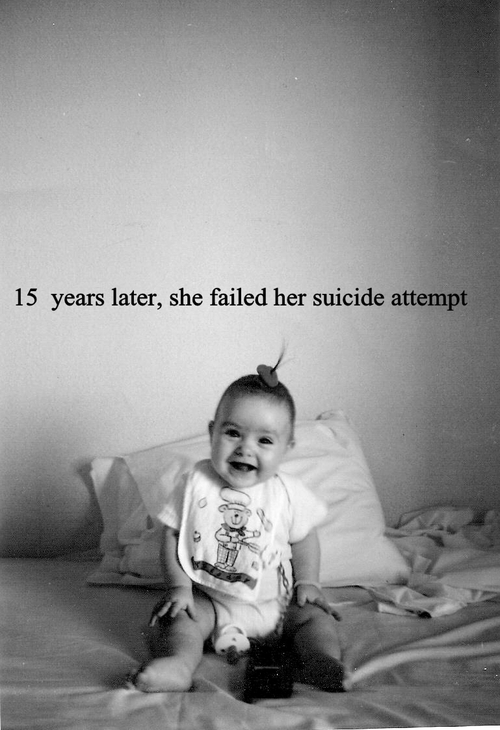
I thought of taking my life once, or rather, constantly for a single period of time.

I can look back at that Scott and see that he was an incredibly sick little boy. He was completely and totally off his nut (sorry for the clinical terminology). I look back at that Scott and I can see clearly how he could believe that he should take his own life. I can re-enter his mind and see what he sees, taste what he tastes. I’m back there right now as I write. He’s crushed, broken, deeply wounded and unable, even unwilling, to lift himself up. He’s insane with grief. Is he capable of believing that he should end it all?

Why not.

I did a lot of things I regret, once a long time ago. It’s easy to wallow in the guilt and the muck and actually believe that this insane, crushed, broken man was fully responsible and incapable of being forgiven. If health has taught me anything it’s that I need to be more gracious to myself when I was sick.

Back to our topic.

I have no idea how you are reading this article but it was intended to bring healing to someone out there who still cannot let go of the anger and the pain. Maybe it will help someone else become more empathetic, more understanding of those who are battling mental health issues. They were insane, and insane people do insane things. It was never your fault. It wasn’t even really their fault. People in their right mind do not take their own life. I know.

Men And The Female Orgasm

Young Couple in Relationship Conflict

You understand how to fix your car. You can recite hockey stats like a scout. You understand renovations. You are good at your job. So why can’t you figure out a clitoris? The G-Spot? Do you really know if she’s faking it?

It is staggering the number of females in a longterm heterosexual marriage or relationship who tell me they rarely orgasm unless they do it themselves. The percentage is so high that I am nervous about how believable it would sound if I ventured a guess. The words, vast majority, have a truthful ring to them. Many women admit that they used to have more pleasure. Often women will tell me that their partner tries to pleasure them. More often than not, however, it’s tempting to just “lie back and dream of England”. So what is the big deal? Why is this so hard?

It really isn’t. It is, however, embarrassing to talk about for many people. I personally LOVE the idea of asking my wife to teach me, but some people don’t swing that way. Most men have learned sexual technique from pornography or trial-and-error or a bit of both. Someone did a study wherein they timed the average length of time it took a woman in pornography to display signs of intense pleasure. The average was somewhere around eleven seconds. I’m sorry but you simply aren’t that good. Anyone who has been in a long-term relationship can tell you that sexual gymnastics settle down after a few years. Infatuation with the opposite sex drops a shocking 80% in that same time. Add kids or communication problems, weariness or stress, and it is going to take a lot longer than eleven seconds before a woman is even going to relax enough to allow the experience to blossom.

The female orgasm takes time. I never realized this years ago but women often report that they need to feel such bizarre things as “safe” and can “trust” before they can let themselves go. As a man it is hard to get my head around such things, but I do try to explain it to other men in a language they can understand. We don’t understand what you really mean by “safe”, but I have been able to explain to dudes how incredibly intimate and potentially violating the sexual act can be for women. As a man I cannot even imagine letting someone do something like that to me just so they will shut up and leave me alone.

Negotiating the female pleasure system can be daunting for men. We have no real teachers and frankly your plumbing can be confusing to the uninitiated. A surprising percentage of men do not know exactly how women pee and where it comes from, precisely. Add to this the confusion we sometimes feel about the female sexual-desire timeline, the way that women seem to behave differently in different circumstances (and we don’t know why), and your seemingly complex thought processes and beliefs about when and why sex is appropriate, and the result is a confused bunch of dudes who have no idea what they are doing. Again, we’re still trying to figure of your plumbing.

I’ll say this as plainly as possible – most men need to be taught how to pleasure a woman and why this is the most important job they have during sex. They need to learn to not be selfish, be taught how to put their needs last. Men have been raised to believe that their pleasure is really all that counts. We have had horrible teachers.

Take the time to talk about your parts. Play Show And Tell. Teach and learn. Learn by doing. Be humble. Take your time.

It will be worth it.

Who Switched The Price Tags?

Tony Campolo tells the story of a group of criminals who break into a department store but don’t steal anything. Instead they went around and switched all the price tags. Just imagine the frustration and confusion! He goes on to talk about the propensity within ourselves to switch the price tags – things that are valuable become not valuable. Once worthless things become important. We start putting stock in things that are not important, or healthy, or helpful.

Couples often do that with each other. Hot button issues like sex and communication become bones of contention, or simply too explosive to see in perspective. We begin to notice the flaws in that other’s character and become unsettled. We fixate on what is lacking and feel unappreciated or unfulfilled.

Expectations have forced us to switch the price tags.

There was a time when you couldn’t wait to connect emotionally with that person, but somehow that doesn’t happen much anymore. We started by putting that girlfriend or boyfriend’s needs before our own. It was all about them. You appreciated that they loved you. But things have changed.

In counseling I am fond of telling people that if they want to be happy in their relationship they need to lower their expectations. I have recently taken a second look at that idea and realize that it is more about changing your expectations than lowering them. Happy spouses remind themselves constantly how fortunate they are that someone else would love them enough to dedicate the rest of their life to that person. When I start telling myself that I am lucky to have a wife like Annette it actually transforms how I treat her, and how often I am offended by her. This crazy chick went way beyond the requirements of friendship. Not only does she love me but she is willing to align her future with mine – a truly stupid thing to do.

The more I cultivate gratitude in my feelings towards my wife the better things seem to go in my relationship. As I change my expectations I change my attitude. It is my choice to take what she says wrong. It is my choice to be offended, or angered, or frustrated. Sure she can piss me off – she can be so female, sometimes. She is like a different, albeit extremely attractive, species. Annette is very, very different than I am and it is tempting to become frustrated or negative towards her when she says or thinks things that a man cannot understand or appreciate.  But here’s the clincher, as they say: the more I celebrate her uniqueness the happier I find myself. The more I try to change her, the more I flail misery around me.

The older I get the more I realize that happiness and contentment are things that I choose, they don’t come naturally.